
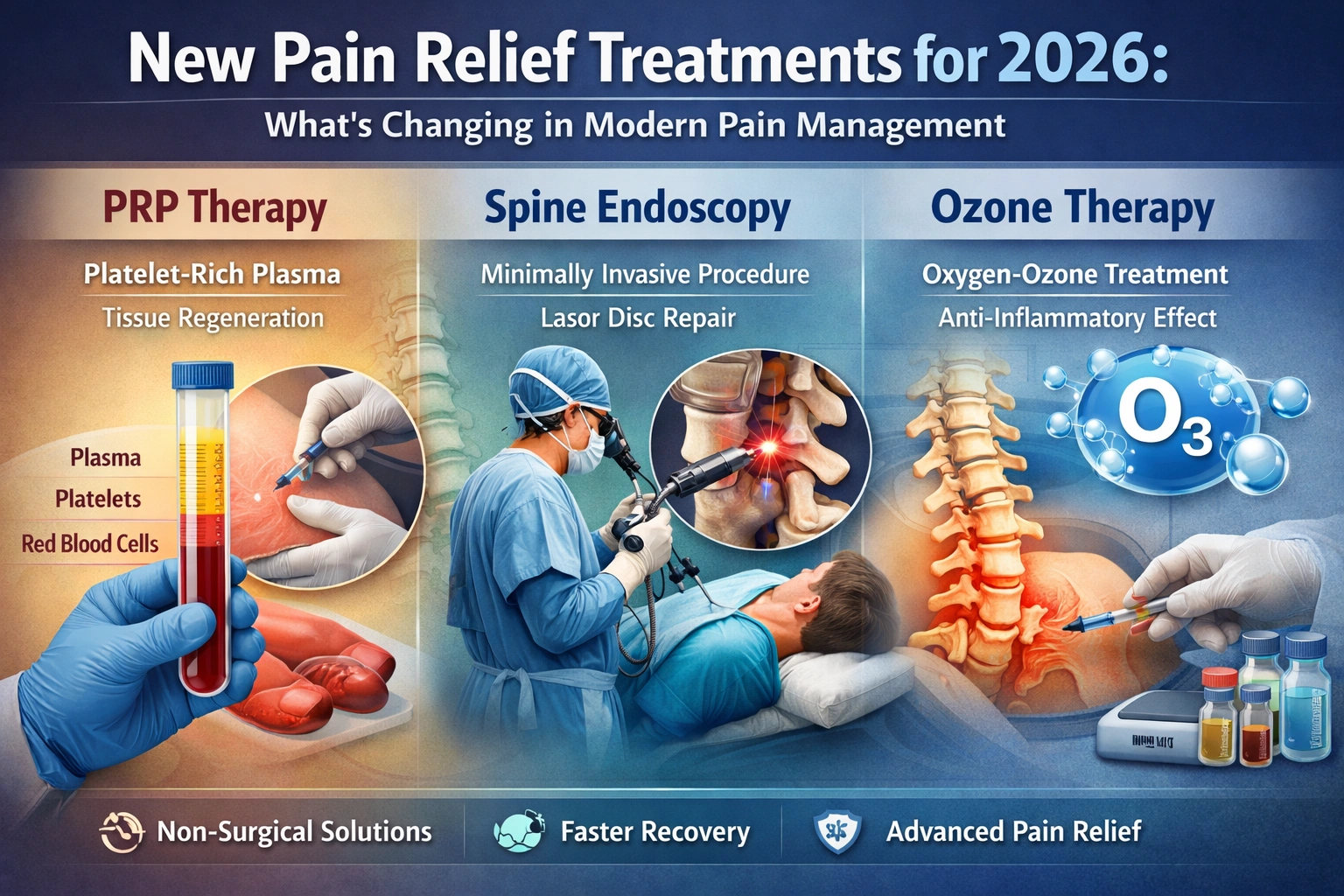
If you are look for new treatements for pain relief 2026 the biggest shift is obvious — pain care is becoming safer, more precise, and more directed towards long-term function and away from short-term symptom suppression. By 2026, patients are being exposed to more non-opioid pain relief treatment methods, conditions specific care plans, and novel non-surgical pain relief alternatives that promote mobility, sleep, and daily comfort before these high-risk medications are used. This direction is supported by current CDC guidance that recommends nonopioid therapies be used for subacute and chronic pain.
How has pain management changed the most over the past 3 years (2026)?
The largest change in pain management is a more focused aspect of treatment. Rather than just hand out the same unspecific pain medicine to each individual, physicians are increasingly looking to identify precisely where the pain originates from first—either nerve tension, inflammation, joint wear and tear, muscle imbalance, post-injury pain or spine-related chronic pain. Why does this matter: Contemporary pain care works best when treatment is tailored to cause. Modern philosophy for the clinic has passed from target = “reduce pain quickly” towards target = “reduce pain safely whilst enhancing physical function and quality of life” The current pain guidance from the CDC, while easily misread, does proclaim that improving pain and function — not just reducing a pain score — is the goal.
And why are non-opioid pain relief treatments attracting increased attention?
Increased focus on non-opioid pain relief treatments is a result of new health guidance which encourages health professionals to prioritize safer treatment pathways when appropriate. According to the CDC, nonopioid and nonpharmacologic therapies are at least as effective as opioids for many acute pain conditions, and the CDC notes nonopioid therapies are preferred for subacute and chronic pain. That is a paradigm shift in how we think clinically. This signifies that a significant number of patients experiencing back pain, neck pain, sciatica, musculoskeletal pain or joint pain can be steered first toward lower-risk alternatives like exercise-based rehab, topical therapies, oral non-opioid medications when applicable and organized physical remediation plans prior to opioid drugs being thought about.
New Pain Relief Treatments 2026 The Latest Medication Trend
Among the most widely reported advances in pain medicines 2026 is FDA approval of Journavx (suzetrigine) in January 2025. Indicated by the FDA as a first-in-class non-opioid analgesic for prescribable use in adults with moderate to severe acute pain. This is significant because it indicates increasing advances in pain medicine focused on pain signals than opioids. But the message patients need to take away is this, this is approval for an acute pain and not a treatment warranted for all chronic pain years. Nonetheless, it’s a good indication that the future of non-opioid pain relief therapies is broadening in significant ways.
Are new non-surgical pain relief options becoming more effective?
Certainly, for many patients who are increasingly multimodal in their pain care, new non-surgical options for pain relief are becoming more robust. In other words, relief is no longer anticipated from one pill or shot. Instead of pill-popping, doctors might mix drug re-evaluation with physical therapy, got exercise, posture correction, weight support, sleep improvement, and/or focal practice, if when required. A layered strategy like this often helps patients control pain more safely and with more sustainability. In particular for chronic back pain, pa- tients are an increasingly recommended part of first-line care based on evidence – an approach that does not use medication.
Is there anything new patients are asking about in terms of non-surgical pain relief in 2026?
Patients who are looking for new treatment options for pain relief are looking for a new treatment option that will help reduce their pain without having to go through major surgery and waiting weeks or months to feel better again. This usually consists of a formal rehabilitation program, movement treatment, topical products, targeted nonopioid medications, and when appropriate, image-guided injections or other focal pain procedures. Complementary approaches are receiving greater recognition, too, for chronic low-back pain. According to National Center for Complementary and Integrative Health, some of the complementary health approaches are included among the treatment options recommended for acute and chronic low-back pain, although some approaches might be useful when applied in well-defined ways.
suggested treatment options for acute and chronic low-back pain and some treatment approaches can be beneficial when appropriately applied.
Does this mean surgery is no longer needed for pain treatment?
No. Surgery will never go out of style, even with the advent of new non-surgical solutions for pain relief. That means for many patients there are now more opportunities to give conservative treatment a try before escalating to more invasive treatment. Few pain disorders get better with rehabilitation, medication change, postural correction, or minor pain procedures. Depending on the diagnosis, others may require specialist assessment. The key takeaway is modern pain management is becoming increasingly targeted and customized. Diagnosis is followed by treatment, not social media buzzwords and empty promises.
In what ways is pain management growing to be more individualized in contemporary times?
Today, doctors are listening more to the stories surrounding pain (its type, etiology, chronicity, and effects on quality of life), resulting in a more personalized approach to modern pain management. Both patients can be complaining of back pain – one may have strain pain related to muscles, whereas the other may have pain related to the nerve, irritation of the disc, or chronic degenerative changes. But in 2026, improved pain management will involve avoiding that type of treatment altogether — those cases will be separated. The ideal treatment regimens today are focused on improving pain, functionality, sleep quality, and ensuring safe return to a healthy lifestyle. This is consistent with current CDC guidance which advocates for patient specific, multimodal, and nonopioid centered pain treatment whenever possible.
Why is this important to patients who experience pain in the spine, back, and nerves?
Why this matters to spine and pain patients: Many people not only want better pain medication — they want better mobility, better sleep and a better quality of life. This is why new pain relief treatments 2026 should be seen less as new medicine then as an old medicine revitalized. This is smarter assessment, safer medication choices, improved rehabilitation planning and stronger implementation of non-opioid pain relief interventions and new non-surgical pain relief modalities, where indicated. This is of particular importance to those with chronic back pain, neck pain, joint pain, sciatica or acute musculoskeletal pain.
New Pain Relief Treatments New Pain Relief Treatments 2026 Headaches: When Should You See a Pain Management Specialist?
Pain Management SpecialistsGet referral to a pain management specialist if your pain is chronic, recurring often, disrupting sleep, affecting work or walking or not responding to simple treatment. Someone who is a trained pain specialist, someone who knows how to look for where the pain is coming from, someone who knows what works and what doesn’t, and can appropriately steer you towards the best option available, be it adjusting your medication, or rehabilitation, or localized treatment, or advanced non-surgical care. We should not aim for only temporary palliative relief. The aim has to be gradual, diagnosis-based, sustainable progress that prioritises safety.
Before you choose any new pain treatment, what should patients keep in mind?
It is crucial to remember that “new” does not mean “best.” Which treatment is best for you depends on your pain and how long you’ve had those symptoms, your medical history, and how you’ve responded to care in the past. An acute pain therapeutic may not be a chronic choice
Do You Want Advanced Pain Relief Without Surgery?
If back pain, neck pain, joint pain, sciatica or chronic nerve pain has a hold on you, the first step towards the right treatment begins with the right diagnosis. Spine & Pain Hospital aims to educate people with pain about the underlying reason behind their pain, and to plan the most suitable treatment for them according to their condition, symptoms and recovery objectives. If you want new pain management treatments 2026, or want to know what are effective non-opioid pain management treatments, non-surgical pain management treatments, our staff can help you approach evidence-based care that is focused on long-term relief and performing better in your daily life.
Contact Spine & Pain Hospital today to talk through your symptoms, considerations of your current treatment, and figuring out what the best step forward is for smarter, safer pain management.
Frequently Asked From New Pain Relief Treatments 2026
The fundamental trend in new pain relief treatments 2026: progress towards safer, more selective, and more individualized treatment. Increased access to non-opioid pain relief therapies, standardized rehabilitation, and innovative non-invasive pain relief methods are among these.
Opioids have been shown to be as effective as nonopioid treatments for many common pain conditions—if given early and appropriately. According to the CDC, nonopioid and nonpharmacologic therapies are as effective or more effective than opioids for many common forms of acute pain and preferred for subacute and chronic pain.
Recent notable advances include the FDA approval of Journavx (suzetrigine) in January 2025 for the treatment of moderate to severe acute pain in adults, the first-in-class non-opioid analgesic.
A lot of these new non-surgical pain relief options are safe when recommended following a thorough assessment. The safety of a treatment depends largely on the condition being treated, the patient's history, and if the treatment is properly being applied with help from a medical professional.
In many cases, yes. However, management of chronic back pain may include a combination of physical therapy, exercise-based recovery, nonopioid medication strategies, and adjuncts. Some patients may also benefit from evidence-based complementary approaches.
People with persistent, long-lasting, or functional impairment pain ought to connect with an experienced discomfort professional to review updated treatment options-- particularly discomfort that precludes walking, sitting, job, sleep, or top quality of life.
Consult with a board-certified local pain doctor for assistance with persistent pain and info about advanced pain management therapies 2026. Spine & Pain Hospital will discuss modern pain management options with patients, including non-opioid pain relief treatments and new non-surgical pain relief options according to individual condition, pain pattern and lifestyle.
Schedule your consultation with Spine & Pain Hospital to explore personalized treatment options for chronic pain, spine pain, joint pain, and nerve-related discomfort.