

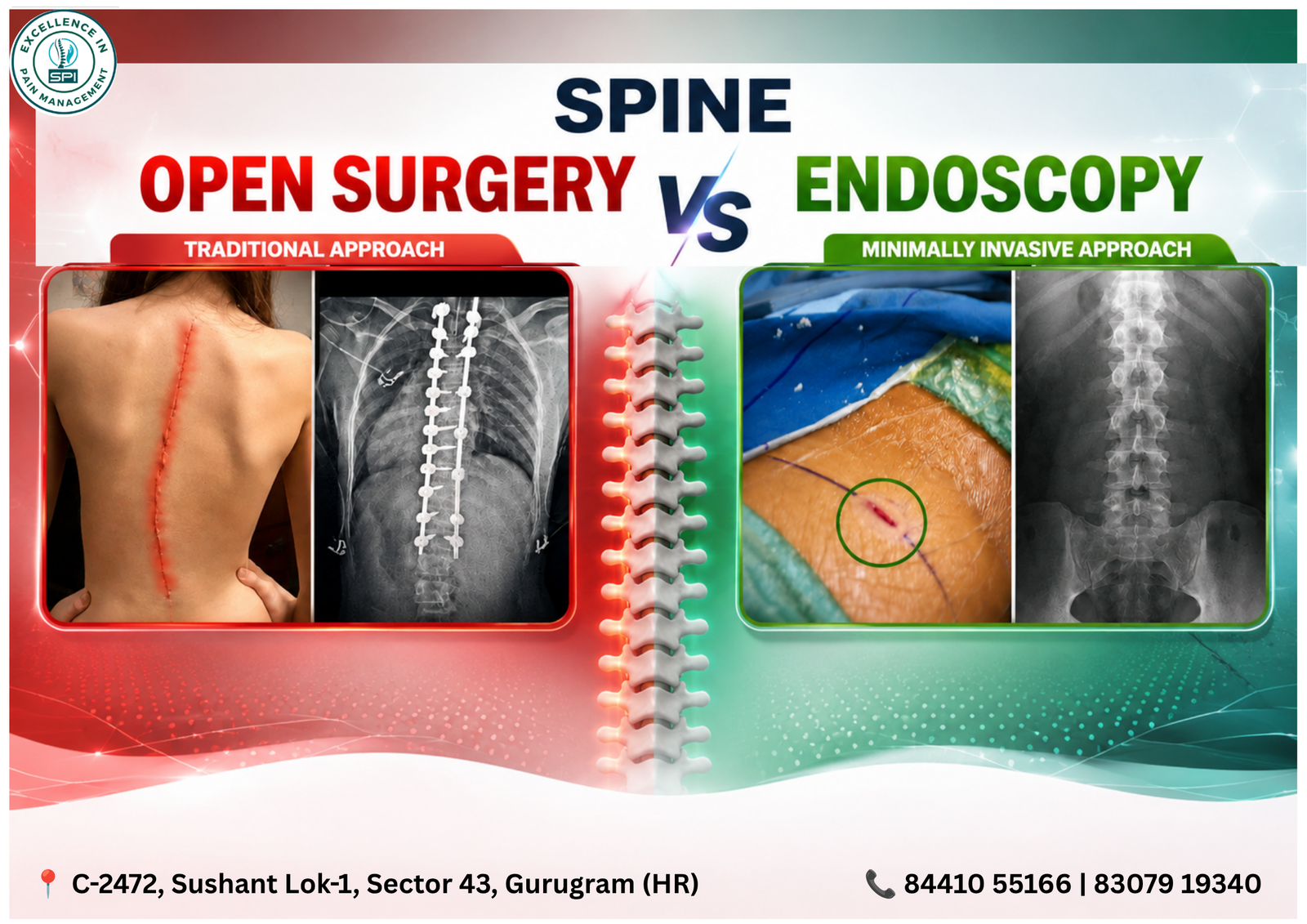
Compare open surgery vs endoscopic spine surgery. Learn differences in recovery, pain, risks, hospital stay, and outcomes to choose the right treatment.
Introduction
If you have been advised to undergo spine surgery, one of the first questions that may come to mind is: Open Surgery vs Endoscopic Spine Surgery: Which is better? This is one of the most searched topics among patients dealing with slipped discs, sciatica, spinal stenosis, and chronic back pain.
Modern spine care has evolved significantly over the last decade. Today, patients have access to advanced minimally invasive procedures that can often provide excellent results with less pain and faster recovery. However, traditional surgery still remains an important treatment option in many cases.
Understanding the differences between Open Surgery vs Endoscopic Spine Surgery can help patients make informed decisions about their treatment journey.
What Is Open Spine Surgery?
Before comparing Open Surgery vs Endoscopic Spine Surgery, it is important to understand what open surgery involves.
Open spine surgery is the conventional surgical technique used to treat spinal disorders. During the procedure, the surgeon makes a larger incision in the back to access the affected area of the spine. Muscles and soft tissues are carefully moved aside to provide direct visibility of the spinal structures.
This method has been successfully used for many years and continues to be an effective option for complex spinal conditions{1}.
Open spine surgery may be recommended for
- Severe spinal stenosis
- Advanced slipped discs
- Spinal deformities
- Spinal instability
- Complex fractures
- Tumors involving the spine
Although highly effective, open surgery generally involves greater tissue disruption compared to newer minimally invasive approaches.
What Is Endoscopic Spine Surgery?
When discussing Open Surgery vs Endoscopic Spine Surgery, understanding endoscopic surgery is equally important.
Endoscopic spine surgery is a minimally invasive procedure performed through a very small incision. The surgeon uses a thin tube equipped with a high-definition camera and specialized surgical instruments.
The camera provides a magnified view of the affected spinal structures on a monitor, allowing precise treatment while minimizing damage to surrounding tissues.
Endoscopic spine surgery is commonly used for
- Herniated discs
- Slip disc
- Sciatica
- Nerve compression
- Lumbar canal stenosis
- Certain cervical spine conditions
The increasing popularity of this procedure has made Open Surgery vs Endoscopic Spine Surgery a major topic of discussion among spine specialists and patients alike.
Open Surgery vs Endoscopic Spine Surgery: Incision Size
One of the biggest differences in Open Surgery vs Endoscopic Spine Surgery is the size of the incision.
Open surgery typically requires a larger incision to expose the affected area of the spine. This allows surgeons to directly visualize spinal structures and perform extensive procedures when necessary.
Endoscopic spine surgery, however, uses a much smaller incision. In many cases, the incision is less than one centimeter long.
A smaller incision usually means
- Less tissue damage
- Faster wound healing
- Reduced scarring
- Improved patient comfort
For patients concerned about recovery, this aspect of Open Surgery vs Endoscopic Spine Surgery is often very important{2}.
Open Surgery vs Endoscopic Spine Surgery: Muscle Preservation
Muscle preservation is another major factor when comparing Open Surgery vs Endoscopic Spine Surgery.
In traditional open surgery, muscles surrounding the spine often need to be separated or retracted to access the surgical area.
While surgeons take every precaution to protect tissues, some degree of muscle trauma is unavoidable.
Endoscopic procedures are designed to minimize disruption of muscles and ligaments. Surgical instruments are inserted through natural tissue pathways whenever possible.
As a result, many patients undergoing endoscopic procedures experience
- Less postoperative pain
- Better mobility
- Faster rehabilitation
This advantage plays a significant role in the ongoing debate about Open Surgery vs Endoscopic Spine Surgery.
Open Surgery vs Endoscopic Spine Surgery: Blood Loss
Blood loss is an important consideration for both patients and surgeons.
In the comparison of Open Surgery vs Endoscopic Spine Surgery, traditional open surgery generally involves greater blood loss because larger areas of tissue are exposed during the procedure.
Endoscopic spine surgery typically results in minimal bleeding due to its precise and minimally invasive nature.
Reduced blood loss can contribute to
- Lower surgical stress
- Faster recovery
- Shorter hospitalization
For many patients, this is another reason why Open Surgery vs Endoscopic Spine Surgery often favors minimally invasive techniques{3}.
Open Surgery vs Endoscopic Spine Surgery: Pain After Surgery
Pain management is a major concern for anyone considering spinal surgery.
When evaluating Open Surgery vs Endoscopic Spine Surgery, postoperative pain is one of the most noticeable differences.
Patients undergoing open surgery may experience more discomfort because larger incisions and greater tissue manipulation are involved.
In contrast, endoscopic surgery generally causes less trauma to surrounding tissues.
Many patients report
- Reduced postoperative pain
- Lower dependence on pain medication
- Greater comfort during recovery
This benefit is one of the primary reasons why discussions about Open Surgery vs Endoscopic Spine Surgery frequently highlight endoscopic procedures.
Open Surgery vs Endoscopic Spine Surgery: Hospital Stay
The length of hospitalization can affect both recovery and overall patient satisfaction.
In many cases of Open Surgery vs Endoscopic Spine Surgery, open procedures require a hospital stay of several days.
Patients may need additional monitoring due to the larger surgical wound and longer recovery process.
Endoscopic spine surgery often allows patients to return home much sooner. Some individuals are discharged on the same day, while others may stay overnight for observation.
A shorter hospital stay can reduce stress and help patients recover in the comfort of their own homes.
Open Surgery vs Endoscopic Spine Surgery: Recovery Time
Recovery is often the deciding factor when patients compare Open Surgery vs Endoscopic Spine Surgery.
Open surgery may require weeks or even months of rehabilitation, depending on the complexity of the procedure.
Patients often need more time before returning to work, exercise, or normal daily activities.
Endoscopic spine surgery is associated with a faster recovery timeline.
Many patients can
- Walk within hours
- Resume light activities quickly
- Return to work sooner
- Regain independence faster
This quicker recovery is one of the strongest arguments in favor of endoscopic procedures when discussing Open Surgery vs Endoscopic Spine Surgery.
Open Surgery vs Endoscopic Spine Surgery: Risk of Infection
Every surgical procedure carries some risk of infection.
When comparing Open Surgery vs Endoscopic Spine Surgery, the size of the incision plays a major role.
Larger incisions used in open surgery may increase the chance of wound-related complications.
Smaller incisions in endoscopic surgery generally reduce exposure and lower infection risk.
Although both procedures are performed under strict sterile conditions, this remains an important difference in Open Surgery vs Endoscopic Spine Surgery.
Open Surgery vs Endoscopic Spine Surgery: Cosmetic Results
Scarring may not be the most important factor, but it is still worth considering.
Open surgery usually leaves a larger visible scar because of the longer incision.
Endoscopic procedures leave a much smaller scar that often becomes barely noticeable over time.
For patients concerned about appearance, this is another area where Open Surgery vs Endoscopic Spine Surgery often favors the endoscopic approach.
When Open Surgery May Be Necessary
While many discussions about Open Surgery vs Endoscopic Spine Surgery focus on the advantages of minimally invasive techniques, open surgery still has an essential role.
Certain spinal conditions require extensive access and reconstruction that cannot always be achieved through an endoscope.
Examples include
- Severe spinal deformities
- Major spinal instability
- Large spinal tumors
- Complex multi-level spine disease
- Advanced trauma cases
In these situations, open surgery may provide the safest and most effective treatment{4}.
Who Is a Candidate for Endoscopic Spine Surgery?
Not every patient is suitable for endoscopic treatment.
The decision between Open Surgery vs Endoscopic Spine Surgery depends on several factors, including
- MRI findings
- Severity of symptoms
- Type of spinal condition
- Previous surgeries
- Overall health
A detailed evaluation by an experienced spine specialist is necessary before determining the most appropriate approach.
The Future of Spine Surgery
Advances in technology continue to change the landscape of spine care.
The conversation around Open Surgery vs Endoscopic Spine Surgery is likely to become even more relevant as minimally invasive techniques continue to improve.
Modern imaging systems, specialized instruments, and enhanced surgical training are making endoscopic procedures more effective and widely available than ever before.
However, both surgical approaches will continue to have an important place in spine treatment{5}.
Conclusion
The comparison of Open Surgery vs Endoscopic Spine Surgery is not about finding a universal winner. Instead, it is about choosing the right procedure for the right patient.
For many individuals with slipped discs, sciatica, and nerve compression, endoscopic spine surgery offers significant advantages, including smaller incisions, reduced pain, faster recovery, shorter hospital stays, and lower infection risk.
At the same time, open surgery remains the preferred option for complex spinal conditions requiring extensive correction or stabilization.
Ultimately, the best decision regarding Open Surgery vs Endoscopic Spine Surgery should be made after a thorough assessment by a qualified spine specialist. A personalized treatment plan ensures that patients receive the most appropriate care and the best possible outcome for their spinal health.
FAQs
1. Is endosco pic spine surgery better than open spine surgery?
Endoscopic spine surgery is often preferred for suitable patients because it involves a smaller incision, less pain, minimal blood loss, a shorter hospital stay, and faster recovery. However, open spine surgery may still be the best option for complex spinal conditions, severe deformities, or spinal instability.
2. How long does recovery take after endoscopic spine surgery?
Most patients can walk within a few hours after endoscopic spine surgery and return to light daily activities within a few days. Recovery time varies depending on the condition being treated, but it is generally much faster than open spine surgery.
3. Is endoscopic spine surgery painful?
Endoscopic spine surgery is designed to minimize tissue damage, which typically results in less postoperative pain compared to traditional open surgery. Many patients require fewer pain medications and experience a more comfortable recovery.
4. Who is a good candidate for endoscopic spine surgery?
Patients with slipped discs, sciatica, nerve compression, lumbar canal stenosis, or certain cervical spine conditions may be good candidates for endoscopic spine surgery. A spine specialist will determine eligibility based on symptoms, MRI findings, and overall health.
5. What is the success rate of endoscopic spine surgery?
Endoscopic spine surgery has a high success rate when performed by an experienced spine surgeon on properly selected patients. Many individuals experience significant pain relief, improved mobility, and a quicker return to normal activities after the procedure.