

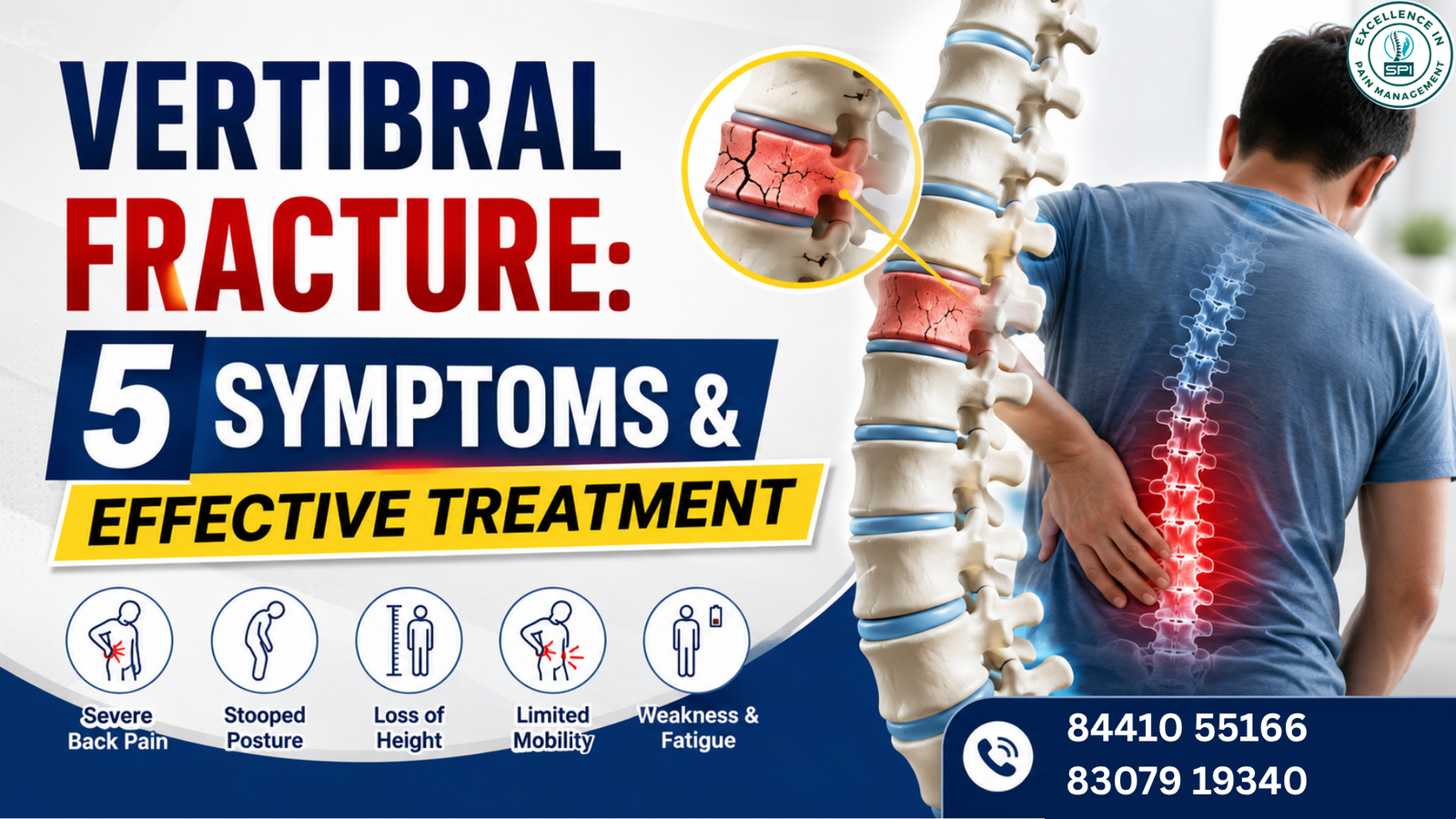
Vertibral Fracture can cause back pain and weakness. Learn 5 key symptoms, common causes, and effective treatment options for faster recovery.
Introduction
Vertibral Fracture can happen when one or more bones in the spine become cracked, compressed, or broken. It can occur after a fall, accident, sports injury, or because the bones have become weak over time. Some people may feel sudden and severe back pain, while others may have mild pain that slowly becomes worse.
The good news is that every spine fracture does not require major surgery. With the right diagnosis and timely treatment, many patients can get effective pain relief and return to their normal activities.
In this blog, we will understand what a Vertibral Fracture is, its common symptoms and causes, available treatment options, and how Spine and Pain Hospital can help patients with spine-related problems{1}.
What Is a Vertibral Fracture?
The spine is made up of small bones called vertebrae. These bones support the body, protect the spinal cord, and help us stand, bend, and move.
A Vertibral Fracture occurs when one of these vertebrae develops a crack or breaks. In some cases, the vertebra can become compressed and lose its normal height. This is commonly called a compression fracture.
A fracture can affect different parts of the spine, including the cervical spine (neck), thoracic spine (upper and middle back), and lumbar spine (lower back).
The severity depends on the type of fracture, the cause, the condition of the bones, and whether nerves or the spinal cord are affected.
What Causes a Vertibral Fracture?
A Vertibral Fracture can have several causes. A sudden injury is one of the most common reasons, but weak bones can also increase the risk.
1. Falls and Accidents
A fall from stairs, a height, or even a hard fall on the ground can put significant force on the spine. Road accidents and other high-impact injuries can also cause spinal fractures.
2. Weak Bones
Osteoporosis makes bones thinner and weaker. Because of this, even a small fall or simple movement may sometimes cause a compression fracture.
This is particularly important in older adults because bone strength naturally decreases with age.
3. Sports Injuries
Contact sports, weightlifting accidents, and activities involving sudden impact can put stress on the vertebrae and increase the risk of injury.
4. Other Bone Conditions
Certain medical conditions can weaken bones and make them more vulnerable to fractures. In these situations, a doctor may recommend additional tests to understand the underlying problem{2}.
5 Common Symptoms of Vertibral Fracture
Symptoms can vary from person to person. Some fractures cause obvious pain, while others may initially go unnoticed.
6. Anterior Pain
In some cases of Vertibral Fracture, pain may also be felt anteriorly, meaning towards the front of the body. This pain can occur due to the compression and structural changes in the affected vertebra.
Here are five common signs to watch for
1. Sudden Back Pain
Pain may start suddenly after a fall, accident, or lifting activity. The pain can sometimes become worse while standing, walking, bending, or changing position.
2. Pain That Gets Worse With Movement
Some patients notice that their pain increases when they move their body. Rest may provide temporary relief, but persistent pain should not be ignored.
3. Reduced Mobility
A spinal fracture may make normal activities difficult. Patients may feel uncomfortable while walking, sitting, standing, or getting out of bed.
4. Change in Posture
Repeated compression fractures can reduce the height of the affected vertebrae. Over time, this may contribute to a forward-bent posture or loss of height.
5. Numbness, Tingling or Weakness
If a fracture affects nearby nerves, a patient may experience numbness, tingling, weakness, or pain that travels into the arms or legs.
These symptoms need medical attention, especially when they appear suddenly or become progressively worse.
When Should You See a Doctor?
Do not ignore severe or persistent back pain after an injury.
You should seek medical evaluation if
- Back pain starts after a fall or accident
- Pain is severe or getting worse
- You cannot move normally because of pain
- You develop numbness or weakness
- Pain travels into your arms or legs
- You have difficulty controlling your bladder or bowel
A timely examination can help identify the problem before it becomes more serious{3}.
How Is Vertibral Fracture Diagnosed?
The first step is usually a detailed medical history and physical examination. The doctor will ask about the injury, pain, movement, and other symptoms.
Depending on the situation, imaging tests may be recommended.
X-Ray
An X-ray can help identify many types of fractures and changes in the shape or height of a vertebra.
CT Scan
A CT scan provides more detailed images of the bones. It can be useful for understanding the exact location and pattern of a fracture.
MRI
An MRI provides detailed images of the spinal cord, nerves, discs, and soft tissues. It may be recommended when nerve compression or other spinal problems are suspected.
The doctor chooses the appropriate test based on the patient’s symptoms and clinical condition.
Vertibral Fracture Treatment Options
Treatment depends on the type and severity of the fracture. There is no single treatment that is suitable for every patient.
The main goal is to control pain, support healing, protect the spine, and help the patient return to normal activities safely.
1. Medicines and Pain Management
For some stable fractures, doctors may initially recommend medicines to control pain and inflammation.
The patient may also be advised to avoid activities that put excessive stress on the spine during the recovery period.
2. Rest and Activity Modification
Short-term activity modification may be helpful. However, prolonged bed rest is generally not the goal because excessive inactivity can lead to muscle weakness and other problems.
A doctor can guide the patient about when and how to gradually return to normal movement.
3. Physiotherapy
Once the fracture is stable and the doctor considers it safe, physiotherapy may help improve mobility, muscle strength, posture, and overall function.
The exercise plan should be based on the patient’s condition rather than following random exercises from the internet.
4. Vertebral Augmentation Procedures
In selected patients with painful compression fractures, minimally invasive procedures may be considered.
5. Surgery for Serious Fractures
Not every spinal fracture needs surgery. However, surgery may be considered when the fracture is unstable, there is significant spinal deformity, or nerves or the spinal cord are at risk.
The treatment decision should always be made after reviewing the patient’s symptoms, examination, and imaging reports.
Vertibral Fracture Treatment Options
The treatment for a Vertibral Fracture depends on the location and severity of the fracture, the condition of the bone, and the patient’s symptoms. At Spine and Pain Hospital, two minimally invasive treatment options are available for selected Vertibral Fracture cases.
1. Kyphoplasty Treatment
Kyphoplasty is a minimally invasive treatment used for selected vertebral compression fractures. In this procedure, a small balloon is placed inside the affected vertebra.
The balloon is carefully expanded to create space inside the vertebra. Special bone cement is then filled into this space to stabilize the vertebra.
Kyphoplasty can help reduce fracture-related pain and improve movement. It may also help restore some of the lost height of the vertebra in suitable cases.
Kyphoplasty is commonly considered in osteoporosis-related compression fractures where the height of the vertebra has reduced. However, it may not be suitable for every patient. The doctor decides the right treatment after checking the patient’s condition and imaging reports.
2. Vertebroplasty Treatment
Vertebroplasty is another minimally invasive treatment for selected vertebral compression fractures.
In this procedure, special medical bone cement is directly injected into the affected vertebra. The cement helps stabilize the vertebra and may reduce fracture-related pain.
Vertebroplasty is generally considered when there is a vertebral compression fracture but there is no significant loss of vertebral height.
The doctor reviews the patient’s symptoms and imaging reports to determine whether Vertebroplasty is the right treatment option.
Kyphoplasty vs Vertebroplasty
Both procedures can be used for selected Vertibral Fracture cases, but the technique used in each procedure is different.
Kyphoplasty: A small balloon is first placed inside the affected vertebra to create space. Bone cement is then filled into this space.
Vertebroplasty: Bone cement is directly injected into the affected vertebra without first creating a space with a balloon.
In simple terms, Kyphoplasty may be considered when there is a loss of vertebral height, while Vertebroplasty may be considered when there is a fracture without significant loss of vertebral height.
The right procedure depends on the patient’s condition, symptoms, and imaging reports. A spine specialist can recommend the most suitable option after a proper evaluation.
Get the Right Vertibral Fracture Treatment
If you have persistent back pain due to a Vertibral Fracture, getting the right diagnosis at the right time is important.
At Spine and Pain Hospital, Kyphoplasty Treatment and Vertebroplasty Treatment are available for appropriate patients. The doctor evaluates your symptoms and imaging reports before recommending the most suitable treatment for your condition.
Can a Vertibral Fracture Heal Without Surgery?
Yes, some stable fractures can heal without major surgery.
The treatment depends on factors such as the location of the fracture, bone health, pain level, spinal stability, and whether nerves are involved.
Some patients may improve with conservative treatment, while others with painful compression fractures may benefit from minimally invasive procedures.
Therefore, it is important not to assume that surgery is always required—or that surgery is never required.
Why Early Treatment Matters
Ignoring a Vertibral Fracture can sometimes allow the condition to become more difficult to manage.
A delayed diagnosis may contribute to ongoing pain, reduced mobility, changes in posture, and loss of quality of life.
Early evaluation helps the doctor understand the fracture and select a treatment plan based on the patient’s individual condition.
Treatment at Spine and Pain Hospital
At Spine and Pain Hospital, the focus is on accurate diagnosis and personalized treatment for spine and pain conditions.
The hospital provides evaluation and treatment options for different spine problems, including back pain, slipped disc, nerve compression, spinal stenosis, cervical pain, and vertebral compression fractures.
The treatment approach is selected after understanding the patient’s symptoms and reviewing relevant imaging reports.
For suitable patients, minimally invasive procedures may be considered when conservative treatment does not provide adequate relief.
A Patient-Focused Approach
Every patient is different. Age, bone strength, fracture type, pain severity, general health, and nerve involvement can all affect the treatment decision.
The aim is not simply to treat the scan report. The aim is to understand the patient and find the most appropriate treatment option.
Meet Dr. Manohar Lal Kanwaria
Dr. Manohar Lal Kanwaria is an Interventional Pain and Spine Specialist associated with Spine and Pain Hospital.
He has experience in the evaluation and management of different spine and pain conditions and focuses on minimally invasive and interventional treatment approaches where appropriate.
His areas of work include spine-related pain, slipped disc, nerve compression, spinal stenosis, and other conditions affecting the spine.
Patients with a Vertibral Fracture can undergo an appropriate clinical evaluation to understand the condition and discuss available treatment options{6}.
Conclusion
A Vertibral Fracture should not be ignored, especially when back pain begins after a fall, accident, or sudden injury. Weak bones can also increase the risk of compression fractures, particularly in older adults.
The first step is proper diagnosis. Once the fracture is understood, treatment can range from medicines and activity modification to physiotherapy and minimally invasive procedures. Serious or unstable fractures may require surgery.
If you have persistent back pain, sudden pain after an injury, difficulty walking, numbness, or weakness, consult a qualified spine specialist for proper evaluation.
Early diagnosis, the right treatment plan, and appropriate follow-up can make a significant difference in recovery and quality of life.
Faq’s
1. What is a Vertibral Fracture?
A Vertibral Fracture is a crack, break, or collapse in one of the vertebrae of the spine. It can happen due to an injury, fall, accident, or weak bones.
2. What are the common symptoms of Vertibral Fracture?
Common Vertibral Fracture symptoms include sudden back pain, pain while moving, difficulty standing or walking, changes in posture, and sometimes numbness or weakness.
3. How is Vertibral Fracture diagnosed?
A Vertibral Fracture is usually diagnosed through a physical examination and imaging tests such as X-ray, CT scan, or MRI, depending on the patient’s symptoms and condition.
4. What treatments are available for Vertibral Fracture?
For selected Vertibral Fracture cases, Spine and Pain Hospital provides two minimally invasive treatment options: Kyphoplasty Treatment and Vertebroplasty Treatment.
5. Can Vertibral Fracture be treated without major surgery?
Yes, selected Vertibral Fracture cases can be treated using minimally invasive procedures such as Kyphoplasty or Vertebroplasty. The suitable procedure depends on the patient’s condition and imaging reports.